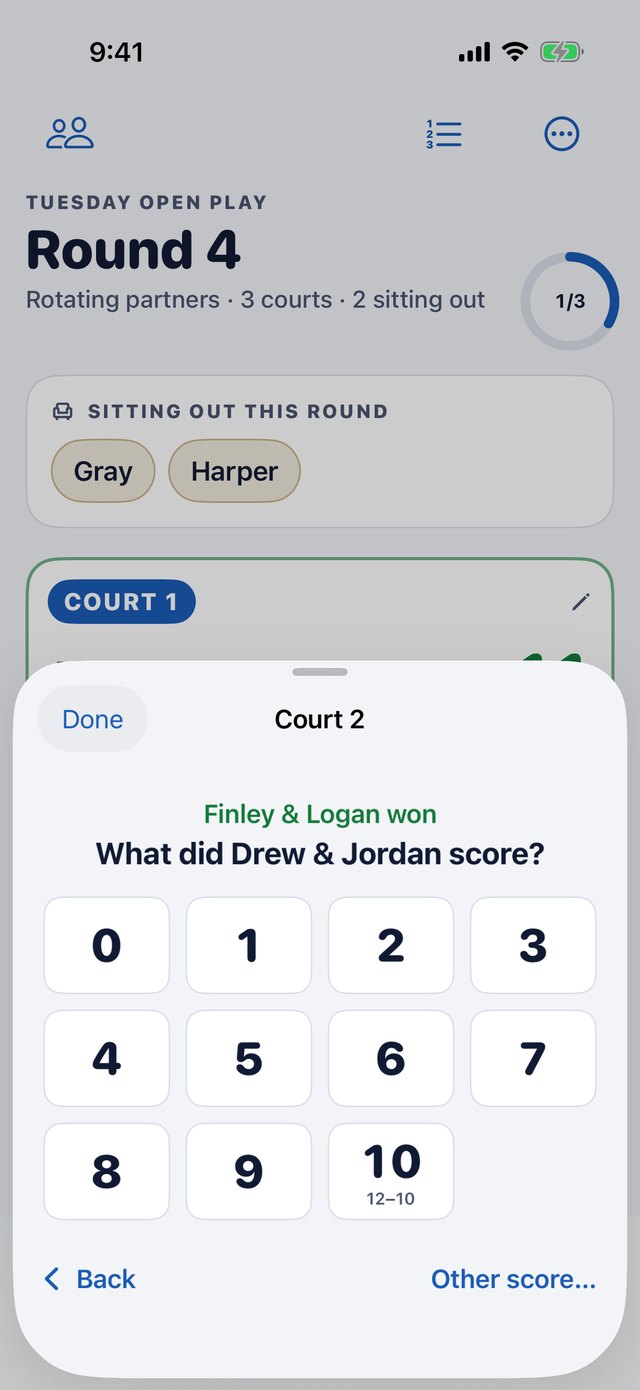
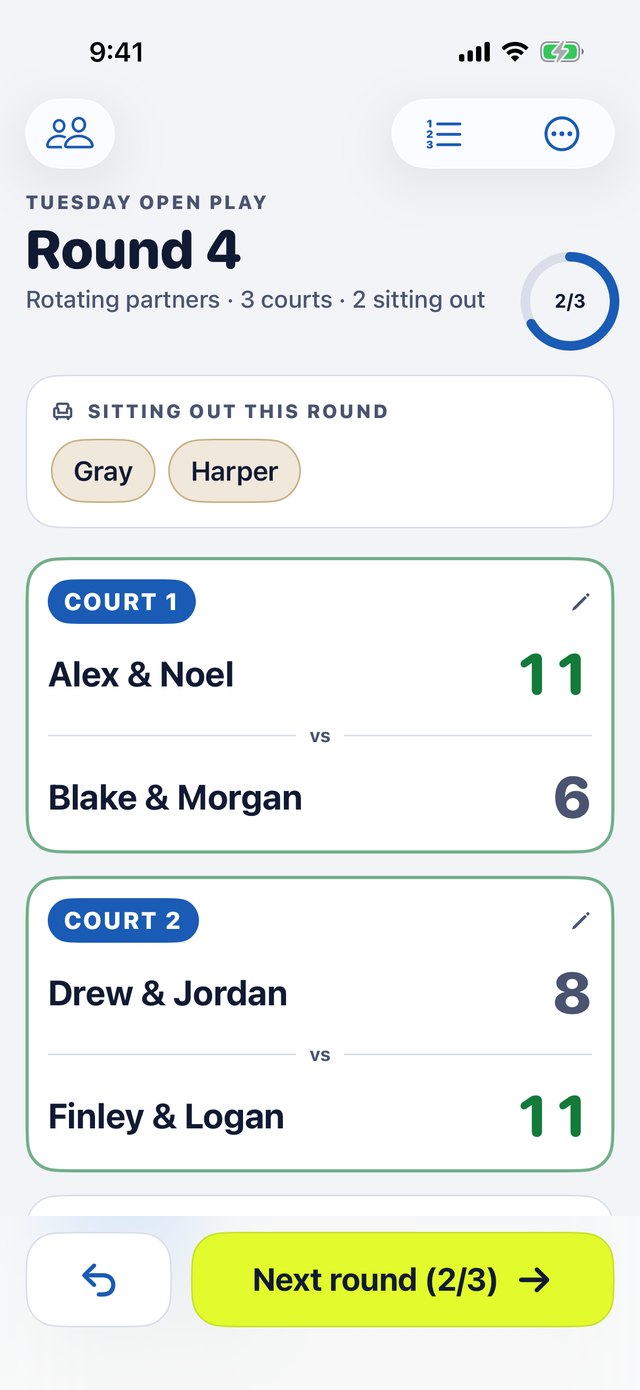
A round, at a glance.
Courts, partners and who sits out, on one screen you can hold up to the group.
 Pickleball round robins
One organizer's phone runs league night or open play: who's on which court, who partners whom, who sits out, the scores and the standings. Players never pay, and they never need the app or an account.
For iPhone and iPad. Any single night is free.
Pick a player count and a number of courts. This board uses the same rule Sitout uses to choose who sits out, round by round.
9 players on 2 courts: 8 play and 1 sits out each round.
The rule: whoever has sat out the fewest times sits next. On a tie, whoever sat longest ago sits, then roster order. So sit-outs never differ by more than one between any two players, and nobody is benched while someone with fewer sit-outs keeps playing. This board shows sit-outs only; the app also rotates partners and opponents every round.
Type in names. That's all a player needs to be. Pick a format and the number of courts, and turn on the mixed-doubles rule if you want it.
Sitout shows each court, who partners whom and who sits out. Enter scores fast between games. Latecomers join and early leavers go mid-night without losing a score, and a wrong tap can be undone.
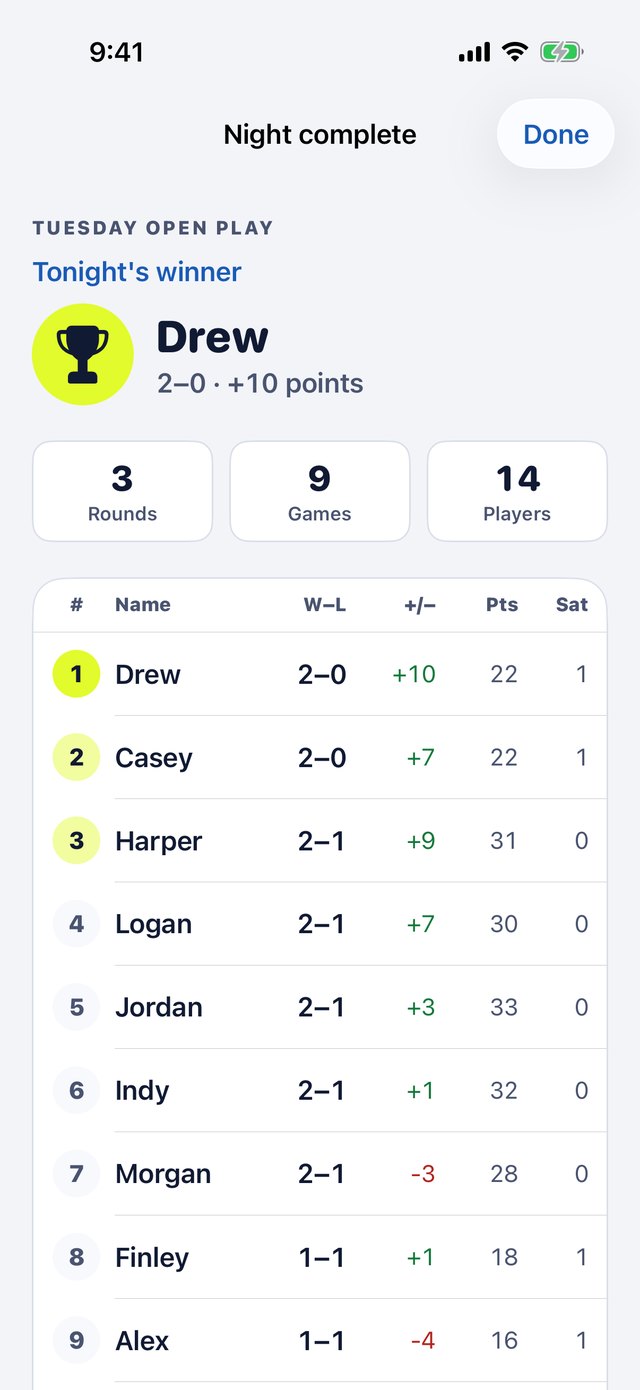
End the night with standings for everyone. Share cards for the next round and the final standings are free, and players can see them without the app.
Set 8 to 20 minutes a round. The countdown is big enough to hold up to a court, shows on the Lock Screen, and buzzes when time's up.
Call the courts what your venue calls them, like “7, 8, 9” or “Pink”. The round, the score pad and every share card use your names.
Give players a level (a DUPR rating or your club's 3.0 to 5.0) and Sitout spreads stronger players across teams so games stay close. Fair sit-outs and fresh partners still come first.
Leaving early? AirDrop the night to a co-organizer. Their phone picks up on the same round, with every score.
Every rotation follows rules you can read right here. They're the same rules the app runs.
Sit-outs never differ by more than one between any two players. Nobody is benched while someone with fewer sit-outs keeps playing. Ties go to whoever sat longest ago, so sit-outs spread through the night instead of piling up at the end.
Sitout spreads partners so repeats are as rare as the math allows, then spreads opponents. With 8 players on 2 courts, everyone partners everyone else exactly once in 7 rounds. See the rotation.
Someone who walks in at round 5 starts level with the group's fewest sit-outs, so they aren't benched to catch up. Someone who leaves early keeps every score already entered. Only the rounds still to come change.
Turn on the mixed-doubles rule and Sitout keeps teams one man and one woman whenever the players on court allow it. Fair sit-outs come first, so nobody sits out of turn just to make a team mixed.
Courts, partners and who sits out, on one screen you can hold up to the group.
Run the same group week after week and Sitout keeps standings across the season.
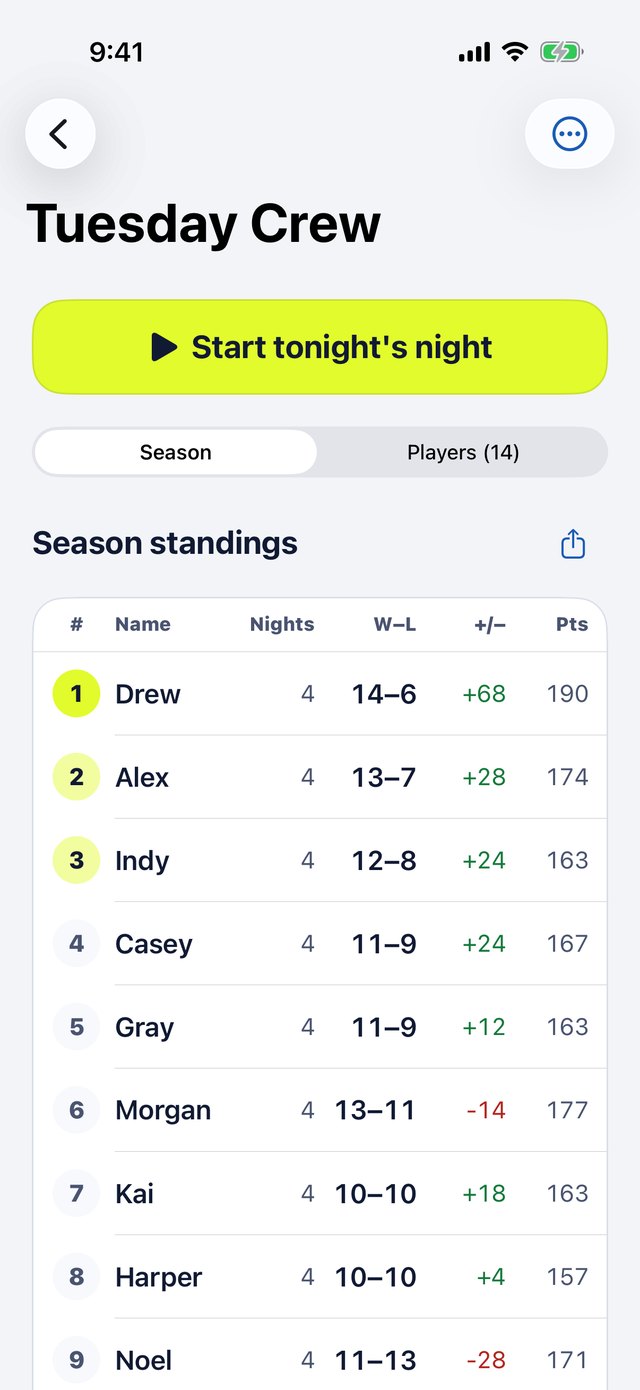
Pick a format before the first round.
Everyone keeps an individual record: your team's result counts for you, whoever you played with. Add the mixed-doubles rule for a mixer.
Teams stay together all night and standings are per team. Every team plays every other team once before any rematch when you have enough courts.
Standings rank by win rate, then point difference per game, then total points. Ranking by win rate means the player who drew one extra sit-out isn't punished for playing one fewer game.
Players never pay. Sitout Pro is for the organizer who runs the same group week after week.
The yearly plan renews automatically until you cancel it in your Apple Account settings. Prices in US dollars. DUPR is a trademark of its owner. Sitout is not affiliated with or endorsed by DUPR.
Players, scores and standings are stored on the organizer's iPhone and leave it only when the organizer shares a card or a CSV file.
No. Only the organizer installs Sitout. Players never pay and never need an account. They see the rounds and standings on the organizer's phone, or on the share cards the organizer sends.
Whoever has sat out the fewest times sits next. On a tie, whoever sat longest ago sits, then roster order. Sit-outs never differ by more than one between any two players, and nobody is benched while someone with fewer sit-outs keeps playing.
Yes. Add a latecomer or mark someone as gone at any point in the night. Scores already entered stay put, and only the rounds still to come change. A latecomer starts level with the group's fewest sit-outs, so they aren't benched to catch up.
With the mixed-doubles rule on, it keeps teams one man and one woman whenever the players on court allow it. Fair sit-outs come first, so on a night with many more men than women (or the other way around), some teams will be two men or two women rather than benching someone out of turn.
By win rate, then point difference per game, then total points. Win rate keeps things fair when sit-outs leave some players with one game fewer than others.
Any single night is free, at any size, in either format, with standings and share cards. Sitout Pro adds saved seasons with standings across weeks, group history and DUPR CSV export, for $29.99 a year or $69.99 once for lifetime.
It needs no account. Sitout has no server: players, scores and standings are stored on the organizer's iPhone and leave it only when the organizer shares a card or a CSV file.
Yes. Any number works. Four players fit on each court and everyone else sits out that round, chosen by the fair rule above. The guide on how many players you need has a table for 4 to 32 players on 1 to 8 courts.
Every schedule in these guides was generated by Sitout's own rotation engine.
Small apps that each do one job well.
Coming soon on the App Store. Any single night is free.